
Motivation theory seeks to explain why we choose to do what we choose to do. It provides a framework for describing and interpreting the factors that energise, sustain and direct the actions that people take. In education, teacher motivation matters because it shapes whether teachers adopt new ideas, and whether they persist when challenges arise. With the introduction of AI technologies into the classroom, our CSEd Botswana research group decided to explore which factors might motivate teachers in Botswana to teach about and use AI.

Botswana offers an important and often underrepresented perspective in research about AI education. Research conducted in the Global North is often underpinned by a level of infrastructure and decision-making governed by tech giants who make decisions for countries in the Global South. In Botswana, there are plans in place to prepare young people for digital futures, but this ambition sits alongside practical constraints such as infrastructure and uneven access to support. Understanding teacher motivation in this context helps us move beyond one-size-fits-all assumptions about how AI education can be introduced in schools.
Research in Botswana
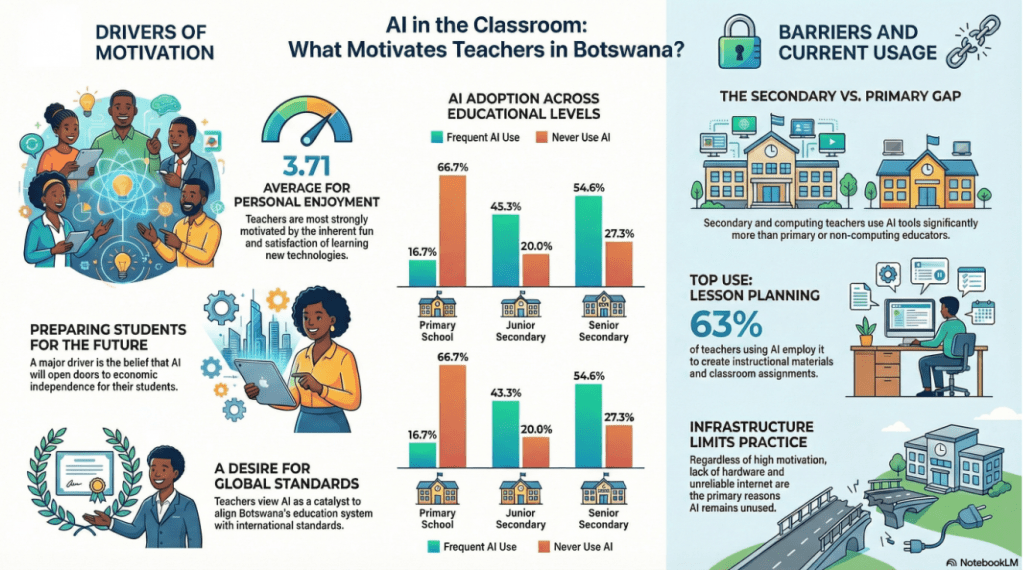
Our international team collaborated last year on a study to explore what motivates teachers in Bostwana to use and teach about AI technologies. Prior to conducting a professional development workshop to teach about AI with Batswanan educators, we administered a mixed-methods survey. The questions in the survey included an adapted Motivation to Teach Computer Science (MTCS) scale to measure dimensions like personal enjoyment and student benefit, as well as open-ended questions about each teacher’s specific goals and perceived challenges. We found that participating teachers who engage with AI in their educational practice use these tools for a variety of preparatory tasks, including creating instructional content, developing content and editing student work. From our sample, teachers at senior secondary schools and computing teachers were more likely to self-report as using AI tools frequently.

The balance of intrinsic and extrinsic motivation
We also explored teachers’ motivation and analysed the results using Self-Determination Theory (SDT). SDT is a theory of motivation that helps explain why people choose to engage in certain activities, and whether that motivation comes from external pressures or from intrinsic factors. SDT explains that intrinsic motivation is supported by three basic psychological needs: autonomy, competence, and relatedness. Teachers are more likely to feel genuinely motivated when they have some control over what they do, feel capable and effective in doing it, and experience a sense of connection with others through their work.
Alongside this, the theory shows that not all extrinsic motivation is the same. External motivations can range from acting to avoid pressure or gain rewards, through to seeking approval, recognising the personal value of an activity, and ultimately integrating it into one’s professional identity and values. Importantly, more recent work in Self-Determination Theory suggests that the more autonomous forms of extrinsic motivation can still be highly positive. Rather than undermining intrinsic motivation, they can support well-being and help sustain engagement over time.
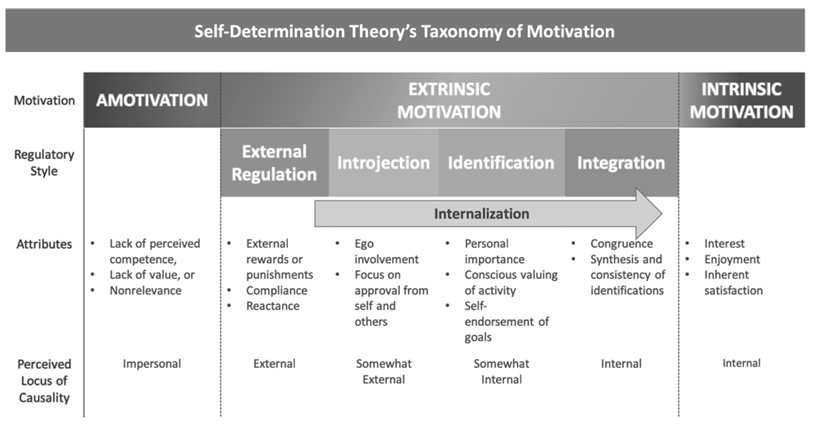
In our study, many teachers in Botswana showed strong intrinsic motivation to teach about AI: they were excited by the chance to learn something new, try out fresh teaching approaches, and stay up to date with technological change. However, their motivation was also shaped by external factors. Some teachers saw teaching AI as part of their professional identity and their role in helping Botswana’s education system move forward. Others valued AI because they believed it could make learning more engaging, help explain difficult ideas, or better prepare students for the future. For some, motivation was also linked to career progression, job security, or the status of teaching an emerging subject.
However, the study also showed that motivation can be difficult to sustain when the wider environment does not support it. Without reliable access to devices and the internet, even highly motivated teachers may struggle to continue. This is why teacher motivation in resource-constrained contexts needs to be understood not just as an individual quality, but as something shaped by the realities of the systems and classrooms in which teachers work.
How motivation theory continues to develop
In recent years, work on motivation theory has taken a situative turn. Rather than treating motivation as a fixed internal characteristic of an individual, researchers are paying more attention to how motivation emerges through the relationship between people and the contexts in which they act. This means recognising that motivation is shaped not only by personal interest, beliefs, or goals, but also by the social, material, and institutional conditions that make action feel worthwhile.
This shift is highly relevant to our study in Botswana. Teachers’ motivation to teach about AI was not simply a matter of whether they were personally interested or confident. It was also shaped by access to devices and internet access, opportunities for support and professional learning, curriculum demands, and broader aspirations for what AI education could mean for their students and for Botswana’s future. A situated perspective helps to move beyond deficit explanations of teacher motivation and instead understand motivation as something relational, contextual, and deeply connected to the realities of practice.
Implications for teaching about AI
These different forms of motivation also have important practical implications for teaching about AI. If teachers are motivated by curiosity and the enjoyment of learning something new, then professional development should give them space to explore and experiment, rather than focusing only on top-down training. If they are motivated because they see AI as valuable for student learning and future opportunities, then AI should be clearly connected to curriculum goals and classroom relevance. Where teachers view AI as part of their professional identity, they should be treated as active partners in shaping how it is introduced, not simply as recipients of reform. And where motivation is constrained by limited devices, internet access, or other practical barriers, teacher enthusiasm alone is not enough. Supporting AI education in resource-constrained contexts means creating the conditions that make it possible to teach well.
To explore the findings in more depth, and to read more about what they mean for teacher motivation and AI education in Botswana, you can read the full paper here.
 CSEd PhD