
Attending a doctoral consortium as a postgraduate researcher is a valuable experience that offers opportunities for academic and personal growth. In this blog post, I will describe my first doctoral consortium, and share insights about what I have learned and how this impacts my PhD journey.
In May 2024, I travelled to Sweden to attend my first doctoral consortium at Uppsala University* as part of the 2nd HCEE (Humanization of Computing and Engineering Education) Conference. A doctoral consortium, or DC for short, is an important part of any PhD students’ journey to becoming an independent researcher. It allows PhD students the opportunity to share their research with other students and experts, encourage discussions about the research topics, and receive feedback on their ideas. Before I travelled to Uppsala, I wrote a 2-page abstract about my research, and prepared a poster to display at the event. I also learned a top tip – if you are flying to a conference with a poster, ask for it to be printed on canvas or cloth rather than paper, as it can be folded and packed, rather than rolled! So, with my poster safely packed away in my suitcase, I boarded the plane and set off for Sweden.
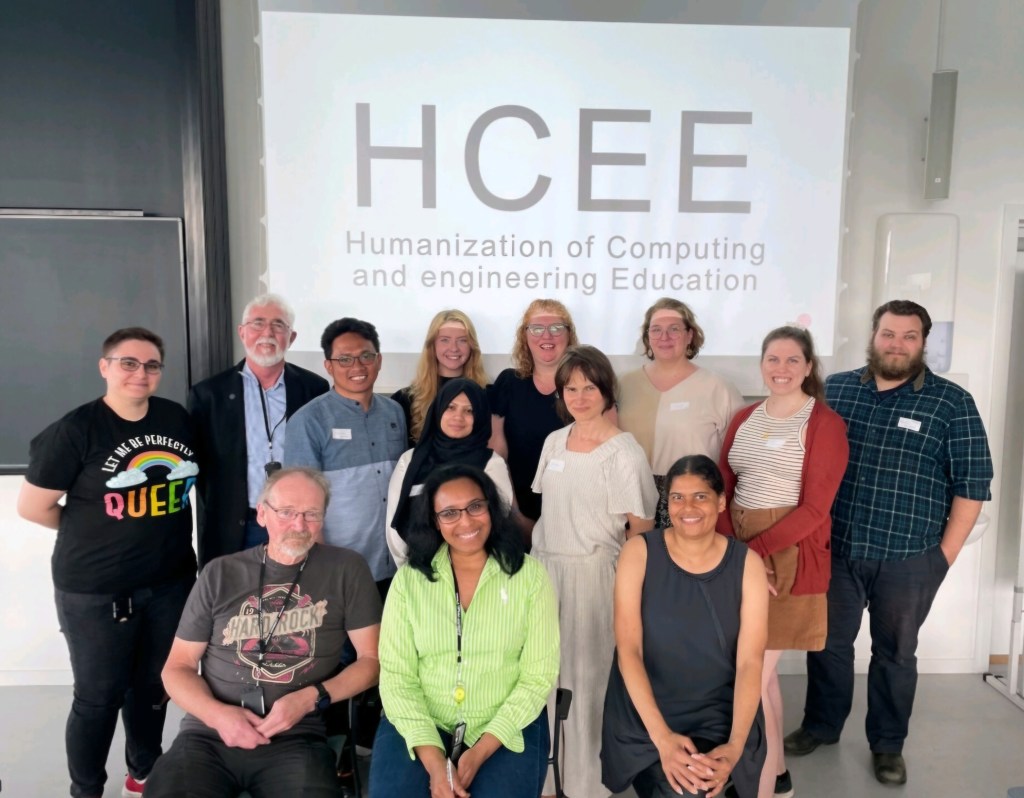
The DC was led by Aletta Nylén, a lecturer, computing education researcher and member of the Uppsala Computing Education Research Group. It was great to have a real mix of nationalities represented at the DC too, although most students were based in Sweden for their doctoral studies. We are all pictured below, along with Professor Mats Daniels and Associate Professor Calkin Suero Montero from Uppsala University, and Tony Clear, Associate Professor at the Auckland University of Technology, who all provided expert feedback on our ideas.
Getting started
We began with a warm welcome to Uppsala, and introductions to each other, before exploring the very pertinent question “Why are you studying at PhD level?”. This was a timely reminder to be aware of our motivations, and keep those in mind over the three, four, five or six years of study that we are undertaking. Studying at doctorate level is a long, immersive and intensive experience, and keeping these goals in mind is essential to stay on track.
Throughout the remainder of the DC, we explored the theme of being able to conceptualise and explain our research to others. We then split into smaller groups of two or three to explain and discuss our PhD work and receive feedback from the expert team at Uppsala University. One question I was asked was whether I intended to develop an instrumental to measure students’ understanding of computing concepts in my research. This was something I hadn’t considered before, but the prompt helped me to clarify that I would prefer to use an existing instrument, or build on something used in a previous study. I also received the very helpful feedback and reminder that teachers are experts in assessing students’ conceptual understanding and that they may be able to suggest suitable assessments.
Fika time
What followed next was my first experience of Fika, a Swedish tradition that is at the heart of daily life. Fika is about having a drink and a snack, but it’s also so much more than that. Fika is also a chance to socialise and chat with colleagues. It’s such a good tradition, that it’s travelled across the North Sea back to the University of Glasgow, where we also have a Fika channel to notify colleagues of drinks and snacks (usually cake!). Fika culture was definitely an important part of the DC, and it prompted us to talk meaningfully to one another in the breaks rather than just sitting individually and scrolling on our phones.
Back as a whole group, we were then tasked with thinking about how we would present our research to someone else. But before we got started on that, we had a surprise task. We had to explain someone else’s research that we had heard about in small groups. We didn’t know this was going to happen, so hadn’t taken any notes and had to reply purely on memory. This was a challenging exercise but really important because it showed what other people remember about your research, what key facts stand out, and what is important to highlight in your own explanations.

Elevator pitches
We had all brought a poster with us to the DC which gave an explanation of our work. I’m pictured above with my poster, which was on display throughout the DC and for the HCEE conference over the following two days. (As a side note, I’ve since learned that using all capitals for titles can cause readability issues and this is definitely Our final task of the day was to create a 2-minute elevator pitch to outline our research to a conference participant and encourage them to look at our poster and discuss the research further.
As a lifelong learner driven by curiosity, research is my fourth career (the previous three being network management; teaching; and community management) and I was able to draw on my experiences of community work and delivering a TedX Talk to create a persuasive pitch. We thought carefully about an engaging opening, finding the right balance of detail and using concrete examples in our presentations. After each pitch, expert feedback from Mats, Tony and Calkin gave us points to consider when we were back in the “real world”.
I found this activity was helpful for two reasons. Firstly, it equipped me with a practical tool that I can use to talk about my doctoral research in the future with colleagues or new connections. Secondly, on a deeper level, I was able to carefully think about the key elements and components of my research and identify what may resonate with others. There’s an excellent blog post published on “The Auditorium” by Dr Zaniah Gonzalez Galofre which unpacks this in more detail.
Looking back and looking to the future
As I look back and reflect on the DC, I am struck by how much we covered in just a few hours, and how we achieved this through rich conversations and collaboration. Thank you to my fellow DC participants (in no particular order) Camilla, Caroline, Fatama, Guilia, Justyna, Pontus, Tiffany and Zuhair. I am looking forward to seeing your updates and hearing more about your work in the future. The doctoral consortium reminded me just how important the two-way exchange of ideas is in research, and has provided me with a boost of confidence and motivation to continue with my work.
*This opportunity was made possible through funding from the Equal Opportunities group at the Department of IT at Uppsala University, and I am very grateful for their support. I also extend thanks to Virginia Grande for their tireless efforts in efforts in securing the funding for my application.
 CSEd PhD